

Sequential Model-Based Optimization
Sequential Model-Based Optimization (SMBO) algorithms build a surrogate model of the objective function to predict which regions are most promising. They are ideal for expensive objective functions where each evaluation counts.
Overview
Algorithm |
Description |
|---|---|
Gaussian Process surrogate with uncertainty quantification. |
|
Tree-structured Parzen Estimators using density estimation. |
|
Random Forest or Extra Trees as surrogate model. |
How SMBO Works
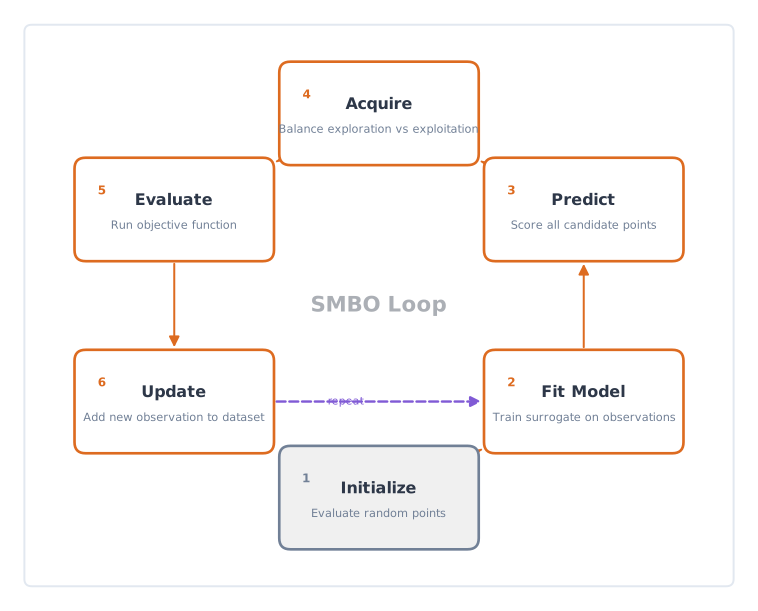
The SMBO loop: fit a surrogate model, use an acquisition function to select the next point, evaluate, and update the model.
The general SMBO workflow:
Initialize: Evaluate a few random points to build initial dataset
Fit Model: Train a surrogate model on observed (parameters, scores)
Acquire: Use the model to select the next point to evaluate
Predict score for all candidate points
Balance exploration (high uncertainty) vs. exploitation (high predicted score)
Evaluate: Run the actual objective function on selected point
Update: Add new observation to dataset, repeat from step 2
When to Use SMBO
Good for:
Expensive objective functions (ML training, simulations)
Limited evaluation budget (< 500 iterations)
Continuous or mixed search spaces
Problems where each evaluation takes seconds to hours
Not ideal for:
Very cheap objective functions (overhead > evaluation time)
Very high-dimensional spaces (> 20 dimensions)
Purely discrete/categorical spaces (use TPE or Forest)
Common Parameters
All SMBO algorithms share:
Parameter |
Default |
Description |
|---|---|---|
|
0.03 |
Exploration-exploitation trade-off in acquisition function |
The xi Parameter
The xi parameter controls how much the algorithm explores uncertain regions
vs. exploits known good regions:
from gradient_free_optimizers import BayesianOptimizer

# More exploitation - focus on known good regions
opt = BayesianOptimizer(search_space, xi=0.01)

# More exploration - try uncertain regions
opt = BayesianOptimizer(search_space, xi=0.1)
Tip
Start with default
xi=0.03Increase if optimization converges too quickly to suboptimal solution
Decrease if optimization wastes iterations on poor regions
Algorithm Comparison
Algorithm |
Surrogate Model |
Uncertainty |
Best For |
|---|---|---|---|
Bayesian |
Gaussian Process |
Covariance |
Continuous, low-dimensional |
TPE |
Kernel Density |
Probability ratio |
Mixed, conditional spaces |
Forest |
Random Forest |
Variance across trees |
Large discrete spaces |
Surrogate Model Comparison
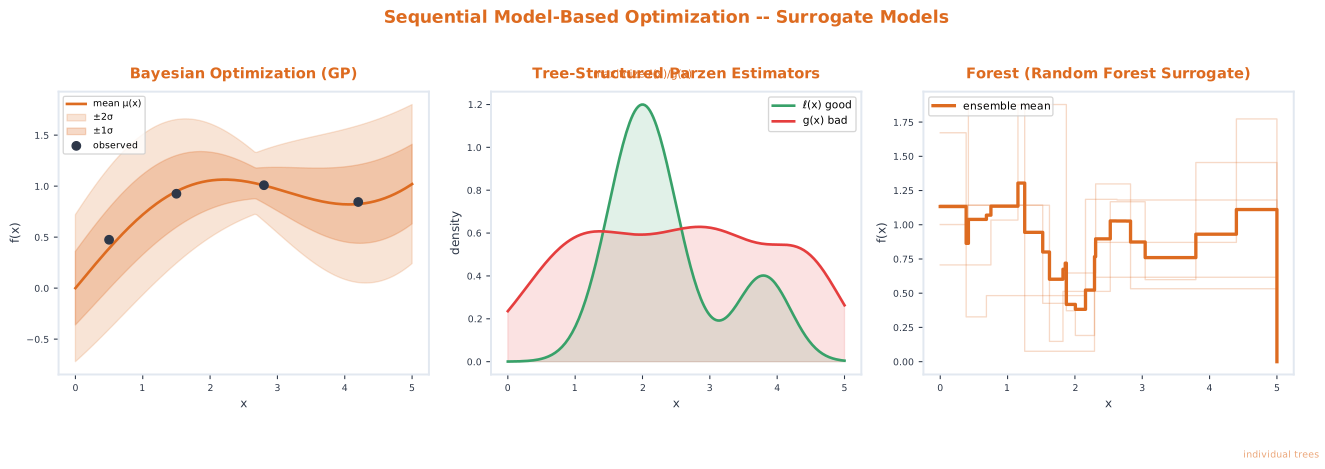
The three SMBO approaches use different surrogate models: GP with uncertainty bands, TPE with good/bad density separation, and Forest with tree ensemble variance.
Visualization
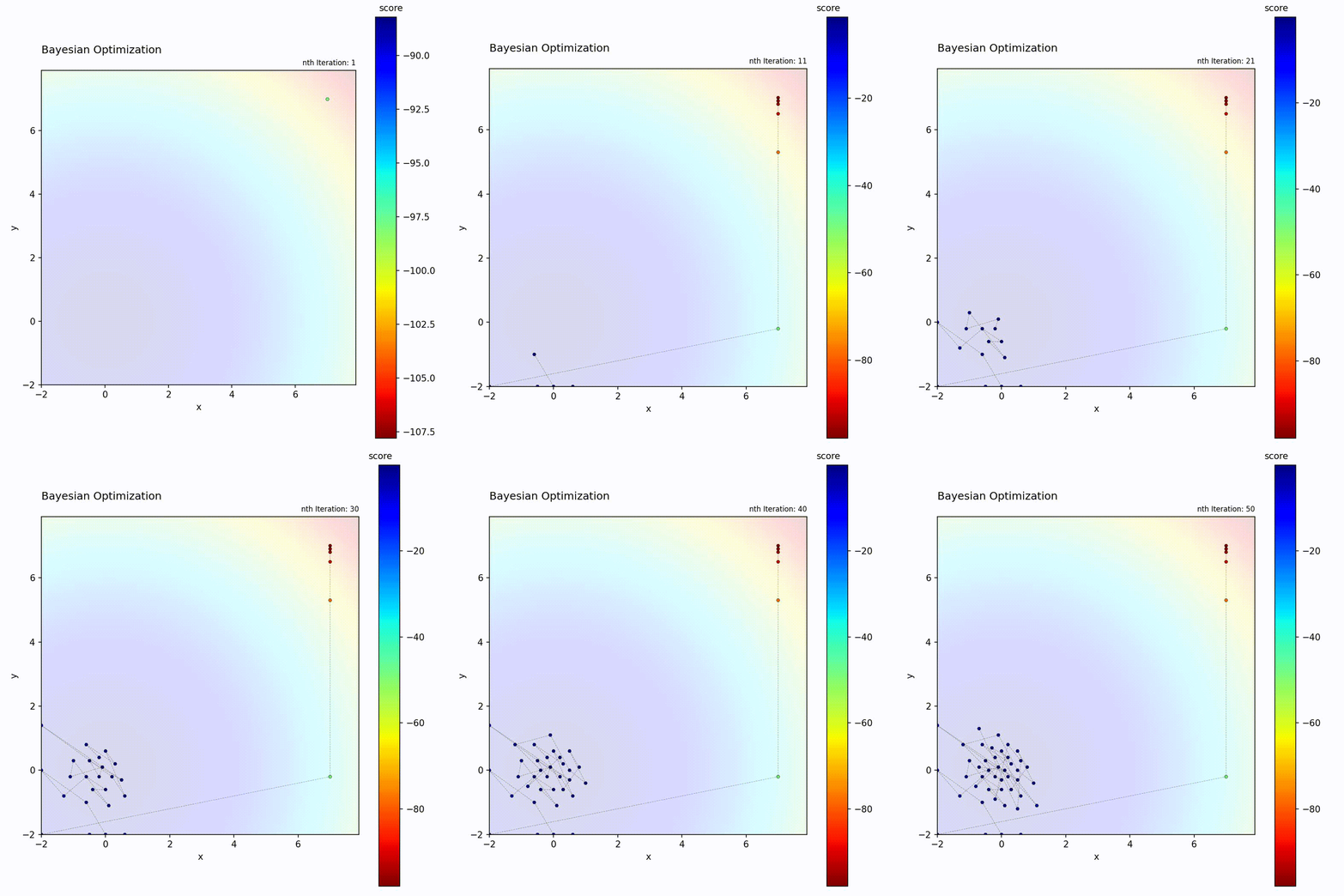
Bayesian Optimization efficiently narrows down to the optimum.
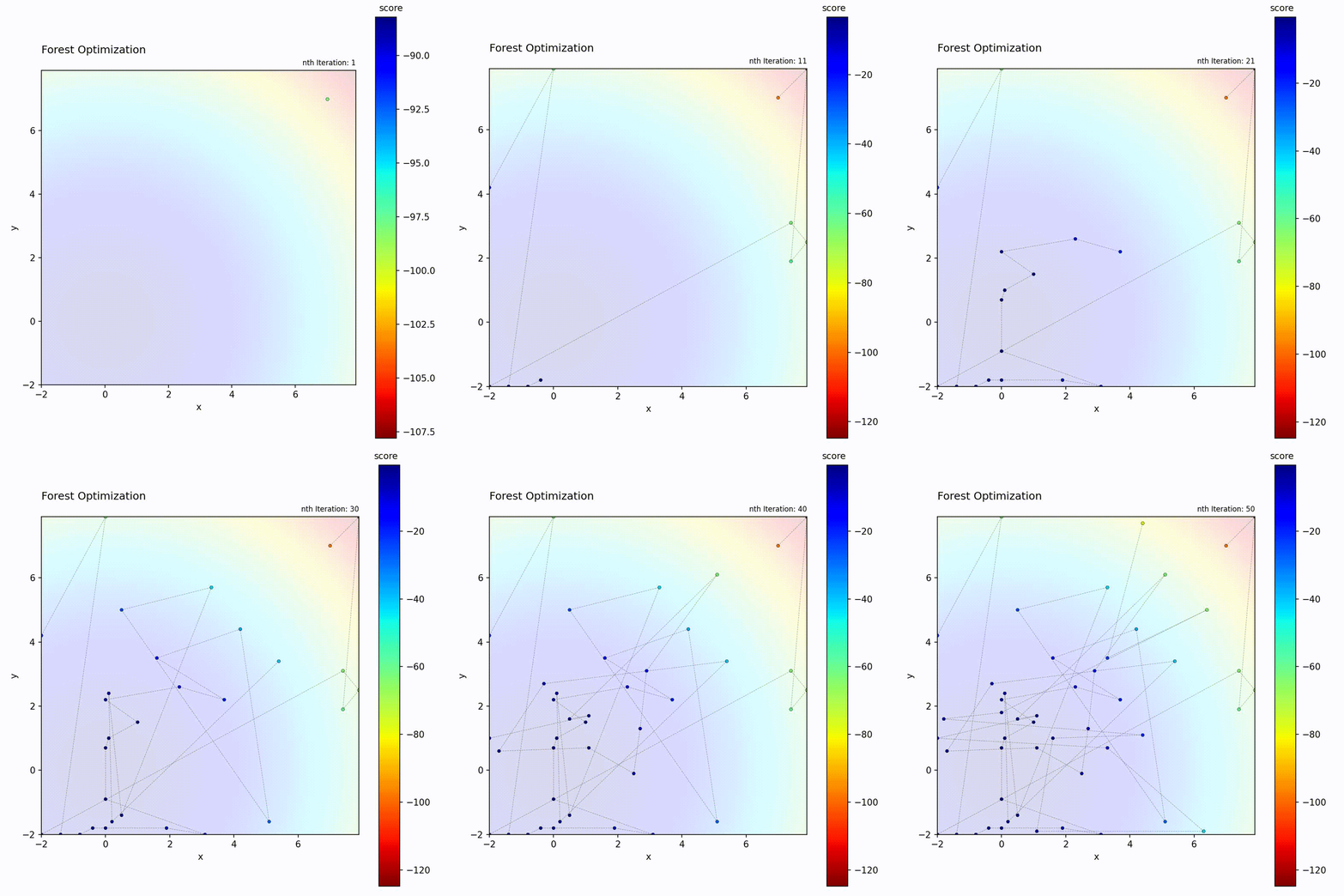
Forest Optimizer uses tree-based predictions.
Example: Bayesian Optimization
import numpy as np
from gradient_free_optimizers import BayesianOptimizer
from sklearn.ensemble import GradientBoostingClassifier
from sklearn.model_selection import cross_val_score
from sklearn.datasets import load_breast_cancer

X, y = load_breast_cancer(return_X_y=True)

def objective(para):
    clf = GradientBoostingClassifier(
        n_estimators=para["n_estimators"],
        max_depth=para["max_depth"],
        learning_rate=para["learning_rate"],
        random_state=42,
    )
    return cross_val_score(clf, X, y, cv=3).mean()

search_space = {
    "n_estimators": np.arange(50, 200, 10),
    "max_depth": np.arange(2, 10),
    "learning_rate": np.linspace(0.01, 0.3, 20),
}

opt = BayesianOptimizer(search_space)
opt.search(objective, n_iter=30)

print(f"Best accuracy: {opt.best_score:.4f}")
print(f"Best parameters: {opt.best_para}")
Computational Cost
SMBO algorithms have higher overhead than other categories:
Model Training: O(n^3) for Gaussian Process, O(n * log n) for trees
Prediction: O(n) to O(n^2) depending on model
For expensive objective functions (> 1 second per evaluation), this overhead is negligible. For very cheap functions, consider simpler algorithms.