

Evolution Strategy
Evolution Strategy (ES) maintains a population of parent solutions and produces offspring through mutation and optional crossover. In each generation, lambda offspring are created by randomly perturbing the parents, all offspring are evaluated, and the best mu individuals are selected to form the next parent population. ES supports two selection schemes: (mu, lambda) selects parents only from offspring, discarding all previous parents; (mu + lambda) selects from the combined pool of parents and offspring. The mutation rate and the offspring-to-parent ratio jointly control exploration intensity and selection pressure.
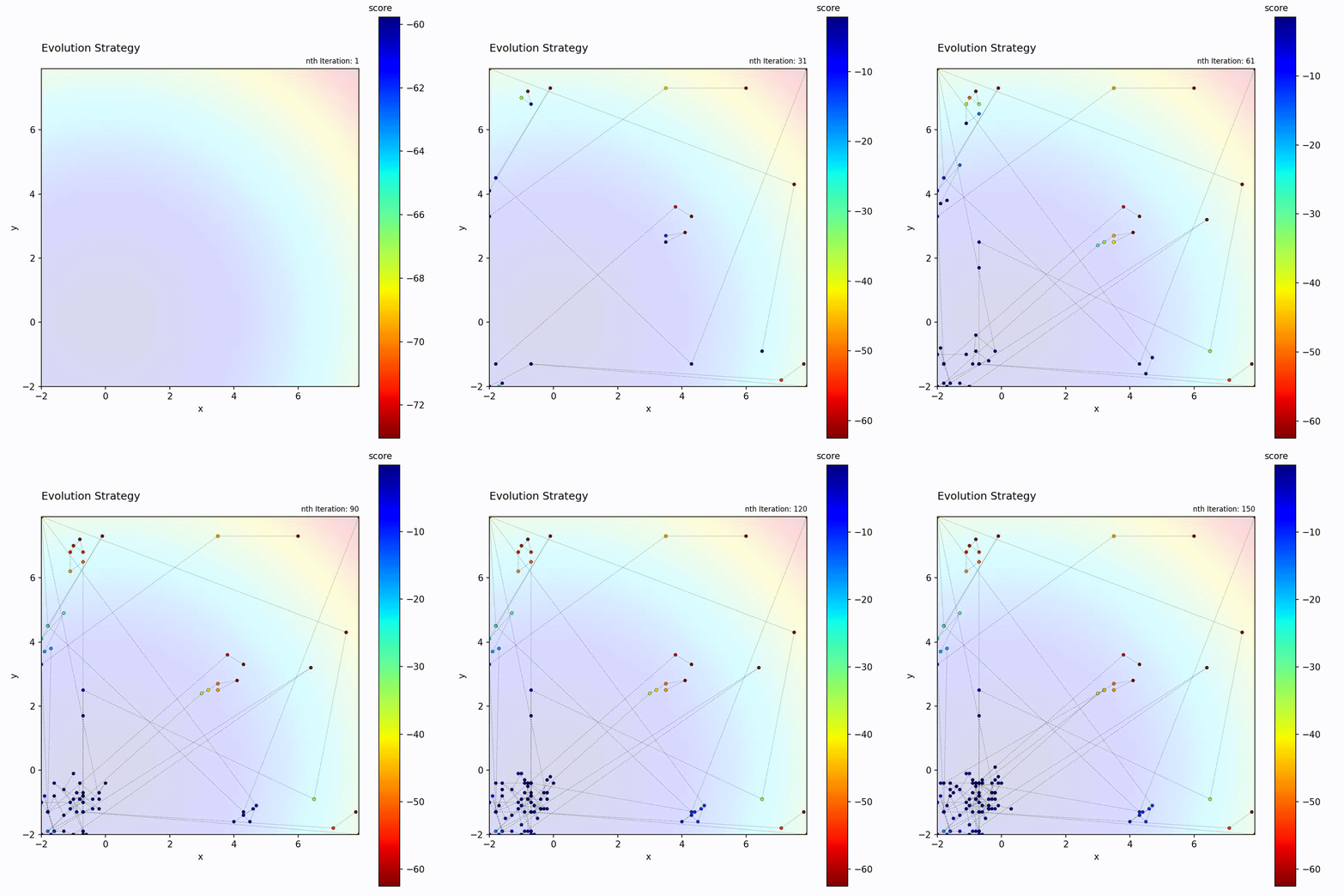
Convex function: Population converges efficiently.
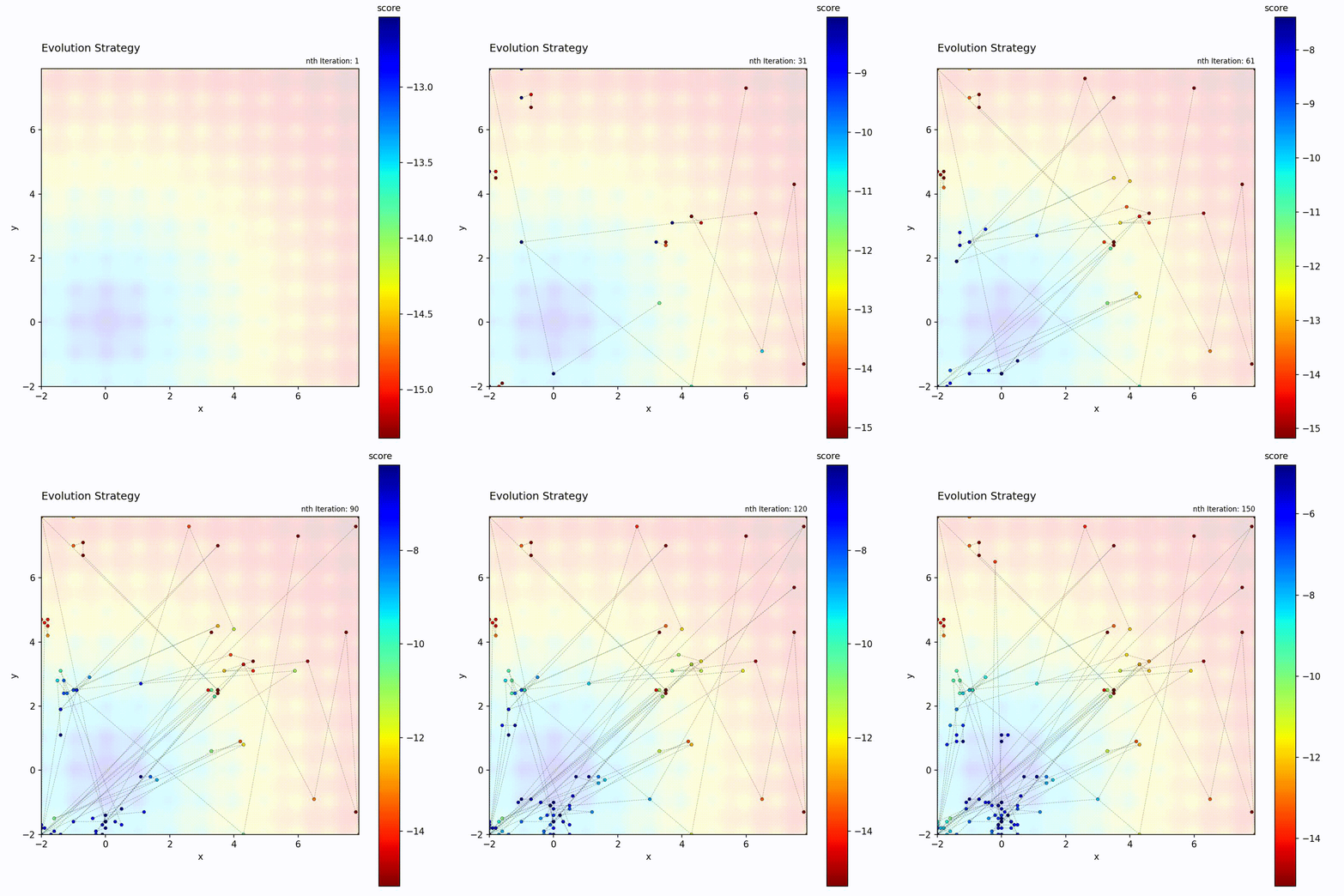
Multi-modal function: Selection pressure guides search.
ES differs from the Genetic Algorithm in this library by treating mutation as the primary operator and crossover as secondary. This makes ES more suitable for continuous, real-valued search spaces where small perturbations are meaningful. The (mu, lambda) scheme is useful for noisy objective functions because it forces re-evaluation each generation and prevents lucky outliers from persisting. The (mu + lambda) scheme is more conservative and appropriate when evaluations are deterministic. Compared to Differential Evolution, ES does not derive its step sizes from population differences, so it requires more careful tuning of mutation rate. ES is a good choice when you need explicit control over selection pressure through the offspring-to-parent ratio.
Algorithm
Each generation:
Mutation: Create offspring by mutating parents
Evaluation: Score all offspring
Selection: Select best individuals for next generation
Crossover (optional): Mix selected individuals
offspring = [mutate(random_parent) for _ in range(lambda)]
if replace_parents:  # (mu, lambda)
    population = select_best(offspring, mu)
else:                # (mu + lambda)
    population = select_best(parents + offspring, mu)
ES can use different selection schemes:
(mu, lambda): Select best mu from lambda offspring only
(mu + lambda): Select best mu from parents + offspring combined
Note
The choice between (mu, lambda) and (mu + lambda) is significant. (mu, lambda) allows the population to “forget” bad parents, which is useful in noisy environments where a previously good solution may have been lucky. (mu + lambda) is more conservative, preserving proven good solutions across generations.
Parameters
Parameter |
Type |
Default |
Description |
|---|---|---|---|
|
int |
10 |
Population size (mu) |
|
int |
20 |
Offspring per generation (lambda) |
|
float |
0.7 |
Probability of mutation |
|
float |
0.3 |
Probability of crossover |
|
bool |
False |
If True: (mu, lambda), if False: (mu + lambda) |
Selection Pressure
High offspring/population ratio: Strong selection, fast convergence
Low ratio: Weaker selection, more diversity
# Strong selection (1:3 ratio)
opt = EvolutionStrategyOptimizer(
    search_space,
    population=10,
    offspring=30,
)

# Weak selection (1:1.5 ratio)
opt = EvolutionStrategyOptimizer(
    search_space,
    population=20,
    offspring=30,
)
Example
import numpy as np
from gradient_free_optimizers import EvolutionStrategyOptimizer

def objective(para):
    return -(para["x"]**2 + para["y"]**2)

search_space = {
    "x": np.linspace(-10, 10, 100),
    "y": np.linspace(-10, 10, 100),
}

opt = EvolutionStrategyOptimizer(
    search_space,
    population=15,
    offspring=30,
    mutation_rate=0.5,
)

opt.search(objective, n_iter=200)
print(f"Best: {opt.best_para}, Score: {opt.best_score}")
When to Use
Good for:
Continuous optimization
Noisy objective functions (robust selection)
Problems where hill climbing variants get stuck
Compared to GA:
ES: Typically continuous, mutation-focused
GA: Often discrete, crossover-focused
3D Noisy Function Example
import numpy as np
from gradient_free_optimizers import EvolutionStrategyOptimizer

def noisy_sphere(para):
    x, y, z = para["x"], para["y"], para["z"]
    noise = np.random.normal(0, 0.1)
    return -(x**2 + y**2 + z**2) + noise

search_space = {
    "x": np.linspace(-10, 10, 200),
    "y": np.linspace(-10, 10, 200),
    "z": np.linspace(-10, 10, 200),
}

opt = EvolutionStrategyOptimizer(
    search_space,
    population=20,
    offspring=40,
    mutation_rate=0.6,
    replace_parents=True,
)

opt.search(noisy_sphere, n_iter=500)
print(f"Best: {opt.best_para}")
print(f"Score: {opt.best_score}")
Trade-offs
Exploration vs. exploitation: High offspring/population ratio increases selection pressure (more exploitation).
mutation_ratecontrols exploration.Computational overhead: Moderate. Producing and evaluating many offspring per generation adds cost.
Parameter sensitivity:
replace_parentsis the key structural choice. UseTruefor noisy problems;Falsewhen evaluations are deterministic.