

Repulsing Hill Climbing
Repulsing Hill Climbing extends Hill Climbing with an adaptive step size that
grows when the algorithm stagnates. While making progress, it behaves identically
to standard Hill Climbing, using a fixed epsilon step size. When no improving
neighbor is found, the algorithm multiplies the current step size by a
repulsion_factor on each subsequent iteration. This growth
continues until an improving position is reached, at which point the step size
resets to its initial value. The result is an automatic alternation between
fine-grained local search and large exploratory jumps.
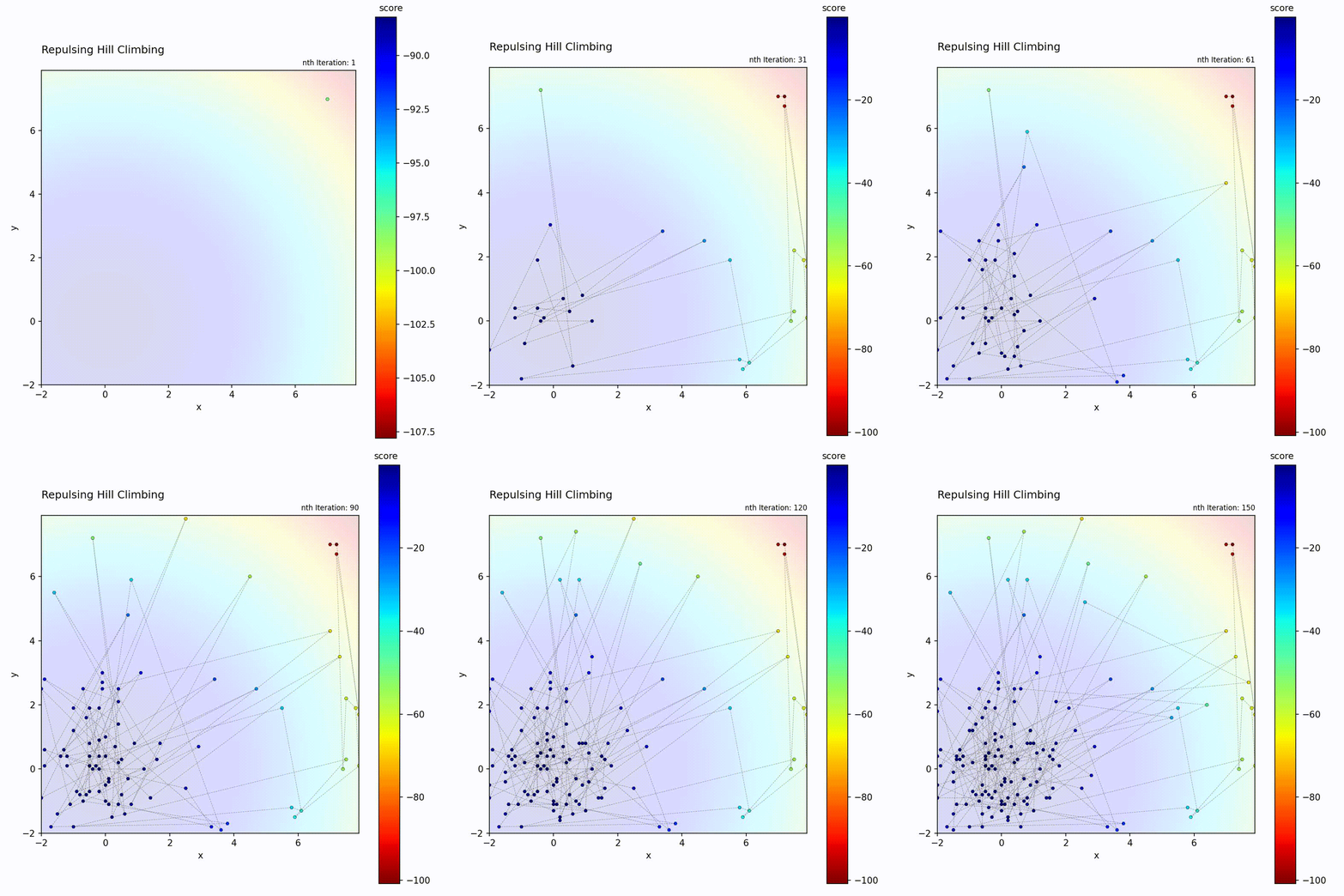
Convex function: Converges normally when making progress.
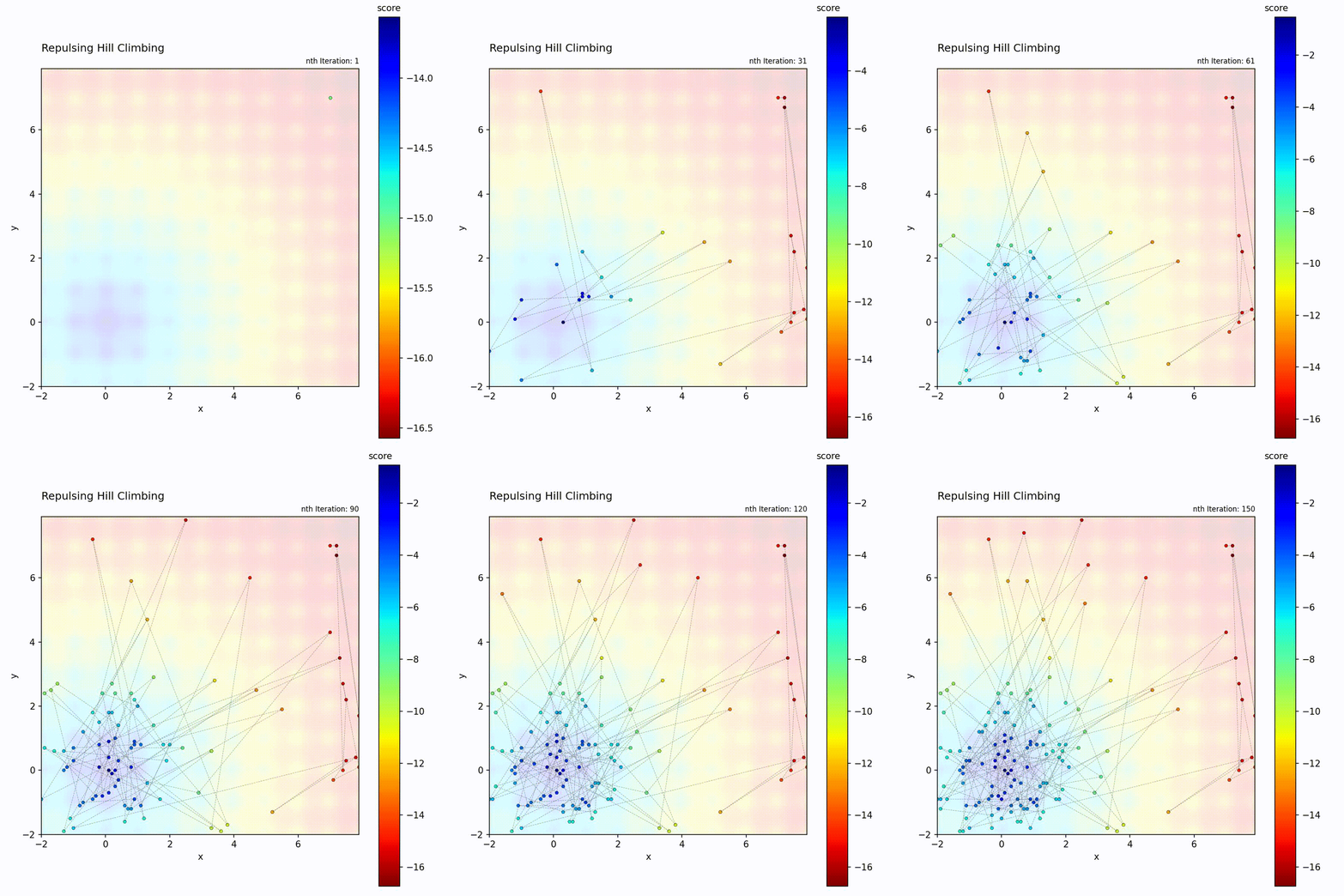
Multi-modal function: Increases step size to escape local optima.
The escape mechanism here is deterministic and reactive, which distinguishes it from both Stochastic Hill Climbing (probabilistic acceptance of worse solutions) and Simulated Annealing (time-dependent acceptance schedule). Repulsing Hill Climbing does not accept worse solutions at all; instead, it increases its search radius until it finds a better position elsewhere. This makes it well suited for landscapes with flat plateaus or wide basins of attraction where small perturbations cannot escape the current region. Choose it when the search space topology is unknown and you want the optimizer to self-adapt its exploration radius without requiring manual parameter scheduling.
Algorithm
At each iteration:
Generate neighbors within current
epsilondistanceEvaluate neighbors
If improvement found:
Move to best neighbor
Reset epsilon to initial value
If no improvement:
Increase epsilon by
repulsion_factorLarger steps help escape flat regions or local optima
if improvement found:
    epsilon = initial_epsilon            # Reset to precise steps
else:
    epsilon = epsilon * repulsion_factor  # Exponential growth
Note
The step size grows exponentially when stuck
(epsilon * repulsion_factor^n), which means the algorithm can very
quickly escape even wide plateaus. But the instant an improvement is found,
epsilon resets to its initial value for precise local search. This
all-or-nothing behavior makes it aggressive at escaping but precise
when making progress.
Parameters
Parameter |
Type |
Default |
Description |
|---|---|---|---|
|
float |
5.0 |
Multiplier for epsilon when stuck |
|
float |
0.03 |
Initial step size |
|
str |
“normal” |
Step distribution |
|
int |
3 |
Number of neighbors per iteration |
The repulsion_factor Parameter
repulsion_factor = 1.0: No increase (equivalent to standard Hill Climbing)repulsion_factor = 5.0: Default, 5x increase when stuckrepulsion_factor = 10.0: Aggressive escape from local optima
The step size grows as: epsilon * (repulsion_factor ** n_stuck_iterations)
Example
import numpy as np
from gradient_free_optimizers import RepulsingHillClimbingOptimizer

def griewank(para):
    x, y = para["x"], para["y"]
    sum_sq = (x**2 + y**2) / 4000
    prod_cos = np.cos(x) * np.cos(y / np.sqrt(2))
    return -(sum_sq - prod_cos + 1)

search_space = {
    "x": np.linspace(-10, 10, 100),
    "y": np.linspace(-10, 10, 100),
}

opt = RepulsingHillClimbingOptimizer(
    search_space,
    repulsion_factor=3.0,  # Moderate repulsion
    epsilon=0.02,
)

opt.search(griewank, n_iter=500)
print(f"Best: {opt.best_para}, Score: {opt.best_score}")
When to Use
Good for:
Functions with flat regions (plateaus)
When standard Hill Climbing gets stuck repeatedly
Problems where you don’t want constant randomness
Compared to other variants:
vs. Stochastic HC: Repulsing uses adaptive step size, not random acceptance
vs. Simulated Annealing: Repulsing increases exploration when stuck, SA decreases it over time regardless of progress
Higher-Dimensional Example
import numpy as np
from gradient_free_optimizers import RepulsingHillClimbingOptimizer

def plateau_function(para):
    """Function with large flat regions and a narrow optimum."""
    x, y, z = para["x"], para["y"], para["z"]
    return -(np.round(x**2 + y**2 + z**2, 1))

search_space = {
    "x": np.linspace(-10, 10, 200),
    "y": np.linspace(-10, 10, 200),
    "z": np.linspace(-10, 10, 200),
}

opt = RepulsingHillClimbingOptimizer(
    search_space,
    repulsion_factor=5.0,
    epsilon=0.02,
    n_neighbours=5,
)

opt.search(plateau_function, n_iter=1000)
print(f"Best: {opt.best_para}")
print(f"Score: {opt.best_score}")
Trade-offs
Exploration vs. exploitation: Automatically adaptive. The algorithm is exploitative by default and only becomes exploratory when stuck.
Computational overhead: Same as Hill Climbing (minimal).
Parameter sensitivity:
repulsion_factordetermines how aggressively the algorithm escapes. Very high values can cause it to jump far from good regions.