

Genetic Algorithm
The Genetic Algorithm (GA) evolves a population of candidate solutions through repeated application of selection, crossover (recombination), and mutation. In each generation, parents are selected with probability proportional to their fitness. Crossover combines parameters from two parents to produce offspring, while mutation randomly perturbs individual parameters. The offspring replace some or all of the current population, and the cycle repeats. The crossover operator is the central mechanism: it assembles new candidates from partial solutions distributed across different individuals in the population.
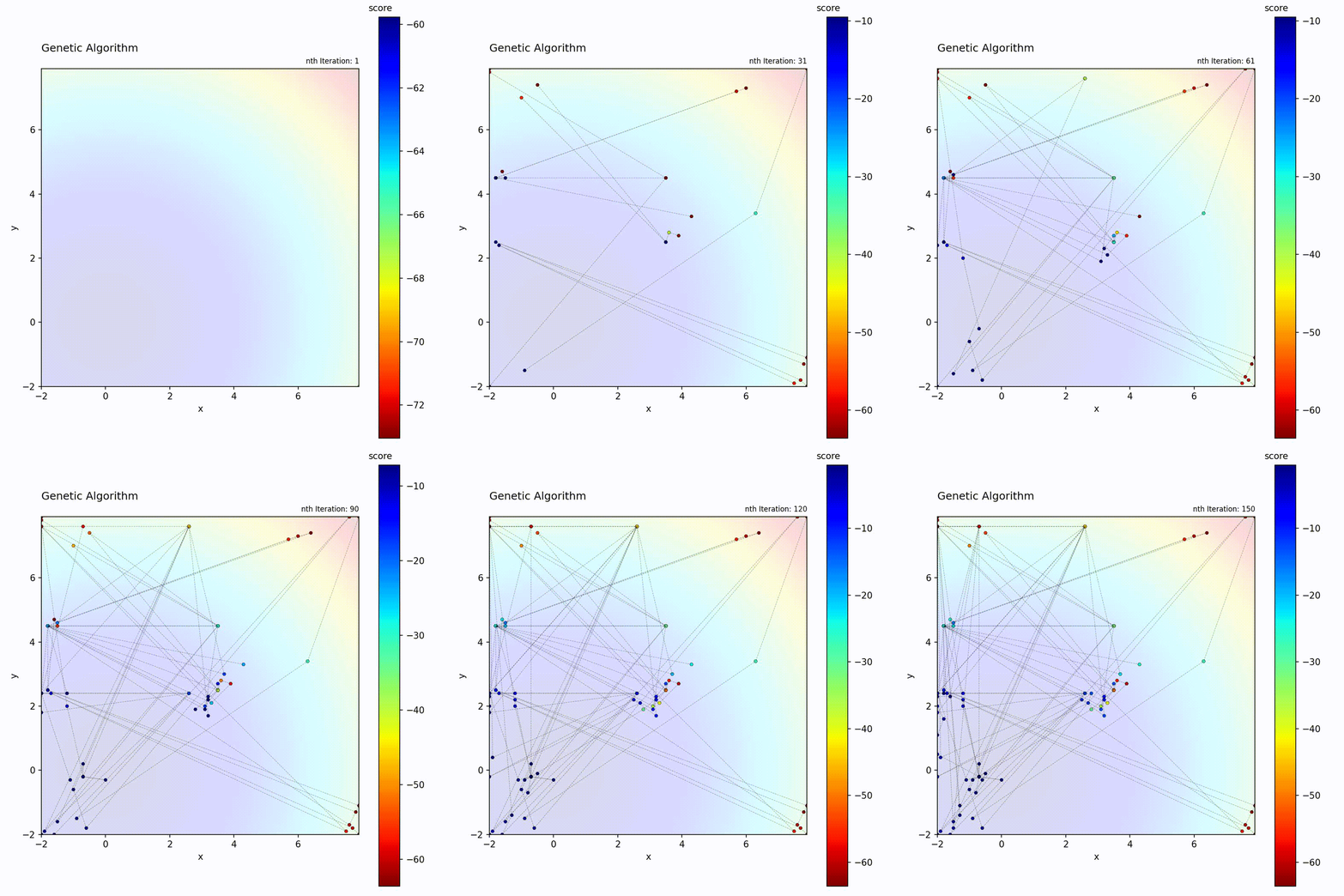
Convex function: Population converges through selection.
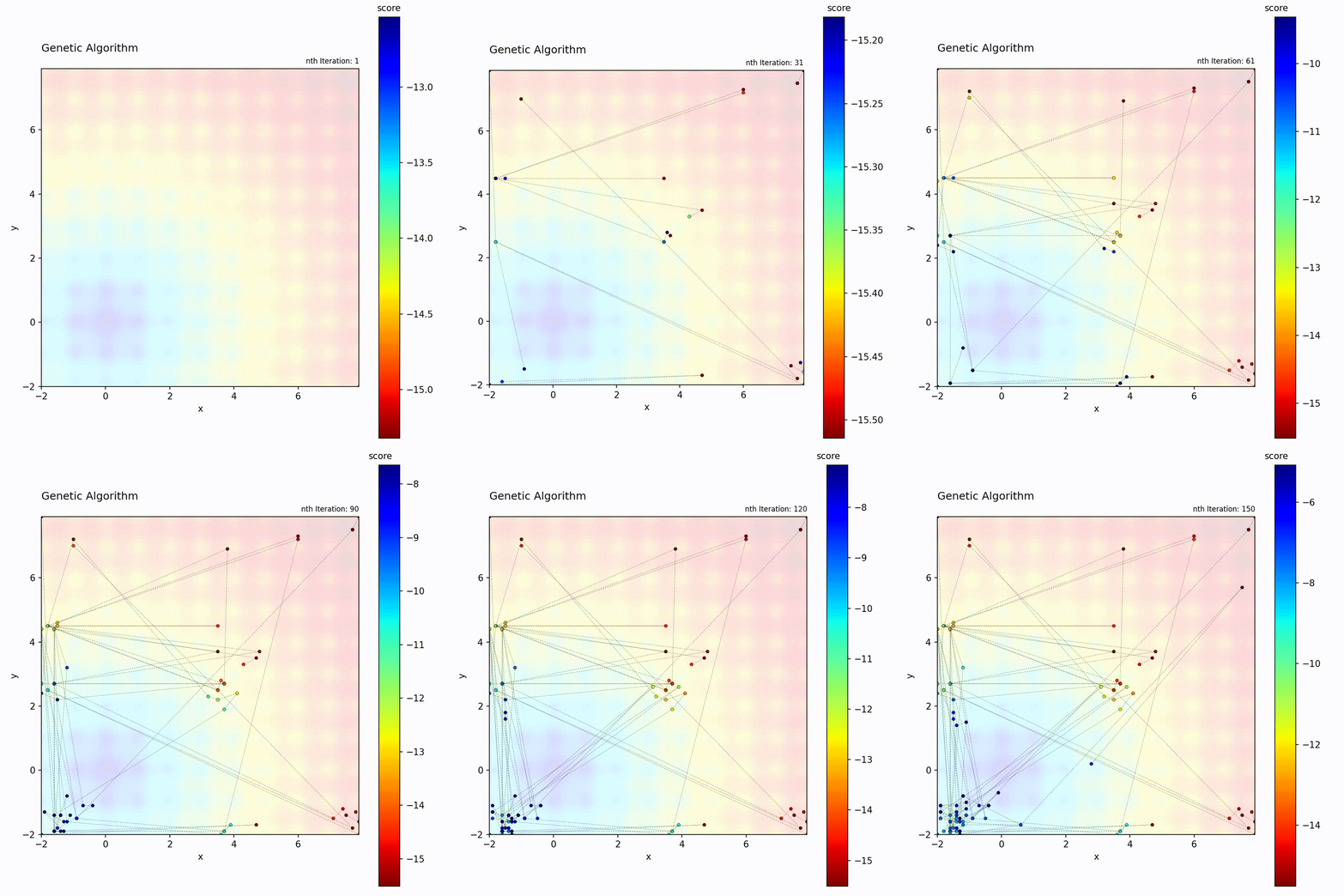
Multi-modal function: Diversity helps explore multiple basins.
Among the evolutionary algorithms in this library, GA is distinguished by its reliance on crossover as the primary search operator. This makes it well suited for discrete and categorical search spaces where the optimal solution is a combination of favorable values spread across multiple candidates. Evolution Strategy and Differential Evolution, by contrast, are mutation-driven and designed for continuous parameters. GA is the preferred choice for feature selection, combinatorial problems, and mixed-type search spaces. On purely continuous landscapes, Differential Evolution or PSO will typically converge faster because their operators are tailored to real-valued search.
Algorithm
Each generation:
Selection: Choose parents from population (fitness-proportional)
Crossover: Combine parents to create offspring
Discrete recombination: randomly pick each gene from either parent
Blend crossover: interpolate between parent values
Mutation: Randomly perturb some genes
Replacement: New generation replaces old (or merge with elitism)
parents = select(population, fitness_proportional)
child = crossover(parent1, parent2, rate=crossover_rate)
child = mutate(child, rate=mutation_rate)
population = replace(population, child)
Note
GA’s crossover operation is what distinguishes it from other evolutionary methods. By combining “genes” from two good parents, crossover can discover solutions that neither parent contained. This is particularly powerful for discrete/combinatorial problems where the optimal solution is a specific combination of features from different regions of the search space.
Parameters
Parameter |
Type |
Default |
Description |
|---|---|---|---|
|
int |
10 |
Population size |
|
int |
10 |
Number of offspring per generation |
|
float |
0.5 |
Probability of mutation per gene |
|
float |
0.5 |
Probability of crossover vs. cloning |
|
str |
“discrete-recombination” |
Crossover method |
|
int |
2 |
Number of parents per offspring |
Crossover Methods
discrete-recombination: Each gene randomly from one parent
Can be extended to blend/arithmetic crossover for continuous parameters
Example
import numpy as np
from gradient_free_optimizers import GeneticAlgorithmOptimizer

def objective(para):
    return -(para["x"]**2 + para["y"]**2)

search_space = {
    "x": np.linspace(-10, 10, 100),
    "y": np.linspace(-10, 10, 100),
}

opt = GeneticAlgorithmOptimizer(
    search_space,
    population=20,
    offspring=20,
    mutation_rate=0.3,
    crossover_rate=0.7,
)

opt.search(objective, n_iter=200)
print(f"Best: {opt.best_para}, Score: {opt.best_score}")
Tuning Tips
Population size:
Larger: More diversity, slower convergence
Smaller: Faster but may lose diversity
Mutation rate:
Higher: More exploration, may disrupt good solutions
Lower: More exploitation, may converge prematurely
Crossover rate:
Higher: More recombination, explores combinations
Lower: More cloning, preserves good individuals
When to Use
Good for:
Discrete and combinatorial optimization
Problems with complex, non-linear interactions
When population diversity is important
Feature selection and subset problems
Not ideal for:
Simple, smooth continuous functions
Very expensive evaluations (large population overhead)
Higher-Dimensional Example
import numpy as np
from gradient_free_optimizers import GeneticAlgorithmOptimizer

def feature_selection_proxy(para):
    """Simulates a feature selection objective."""
    features = [para[f"f{i}"] for i in range(6)]
    # Prefer solutions with fewer active features but good coverage
    active = sum(1 for f in features if f > 0.5)
    quality = sum(np.sin(f * 3) for f in features)
    return quality - 0.5 * active

search_space = {
    f"f{i}": np.array([0.0, 1.0])
    for i in range(6)
}

opt = GeneticAlgorithmOptimizer(
    search_space,
    population=30,
    offspring=30,
    mutation_rate=0.2,
    crossover_rate=0.8,
)

opt.search(feature_selection_proxy, n_iter=500)
print(f"Best: {opt.best_para}")
print(f"Score: {opt.best_score}")
Trade-offs
Exploration vs. exploitation:
mutation_ratedrives exploration;crossover_ratecombines existing solutions (exploitation of known good regions). Population size provides baseline diversity.Computational overhead: Moderate. Selection, crossover, and mutation all add overhead per generation.
Parameter sensitivity: The balance between mutation and crossover rates is critical. Too much mutation destroys good solutions; too little leads to premature convergence.