

Parallel Tempering
Parallel Tempering runs multiple Simulated Annealing instances (replicas) simultaneously, each operating at a different temperature. High-temperature replicas accept worse solutions frequently and explore broadly, while low-temperature replicas accept only improvements and exploit locally. At regular intervals, adjacent replicas attempt to swap their states based on a Metropolis-style acceptance criterion. This swap mechanism allows promising regions discovered by high-temperature replicas to be refined by low-temperature replicas, and allows stuck low-temperature replicas to escape through high-temperature exploration.
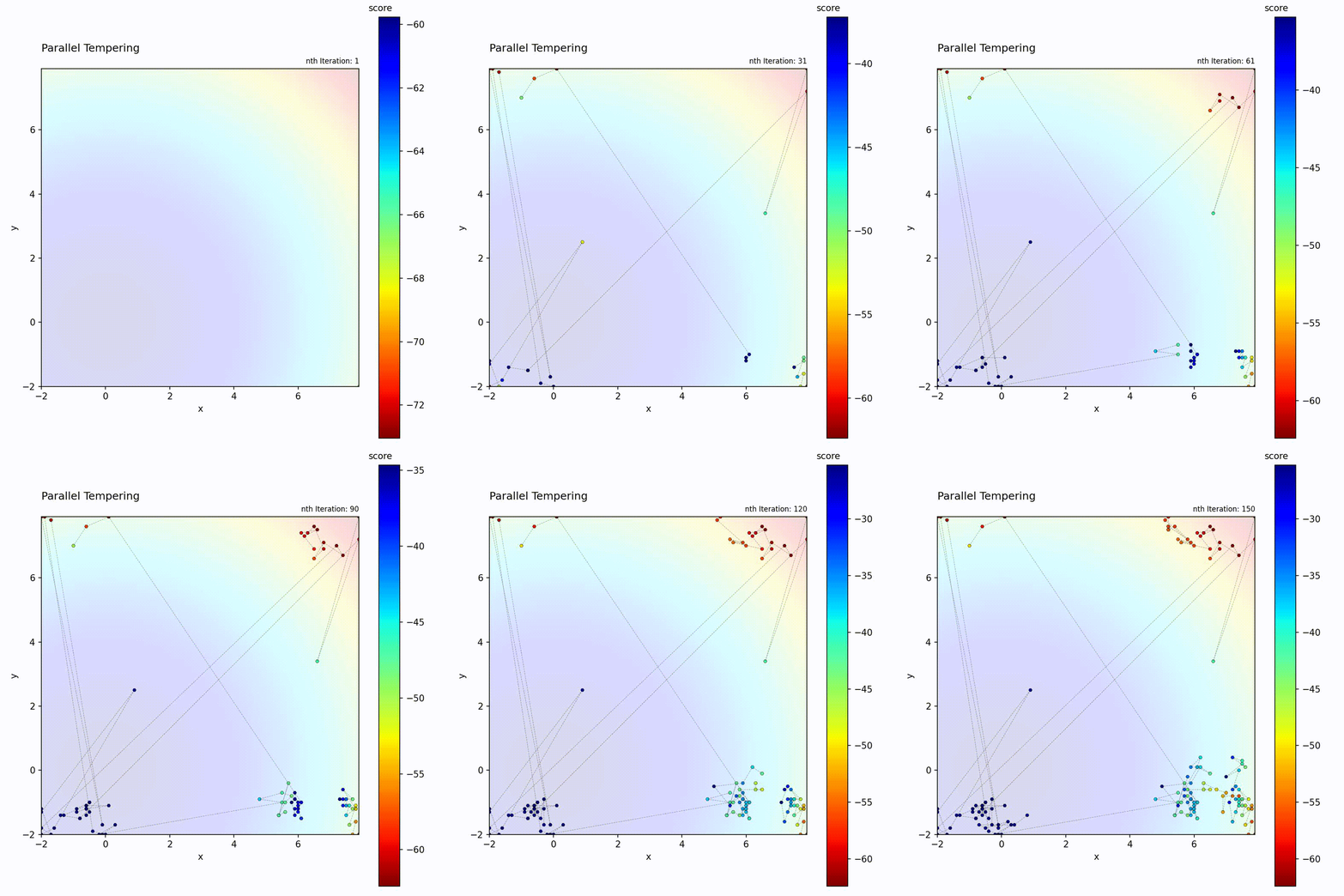
Convex function: Multiple replicas at different temperatures converge cooperatively.
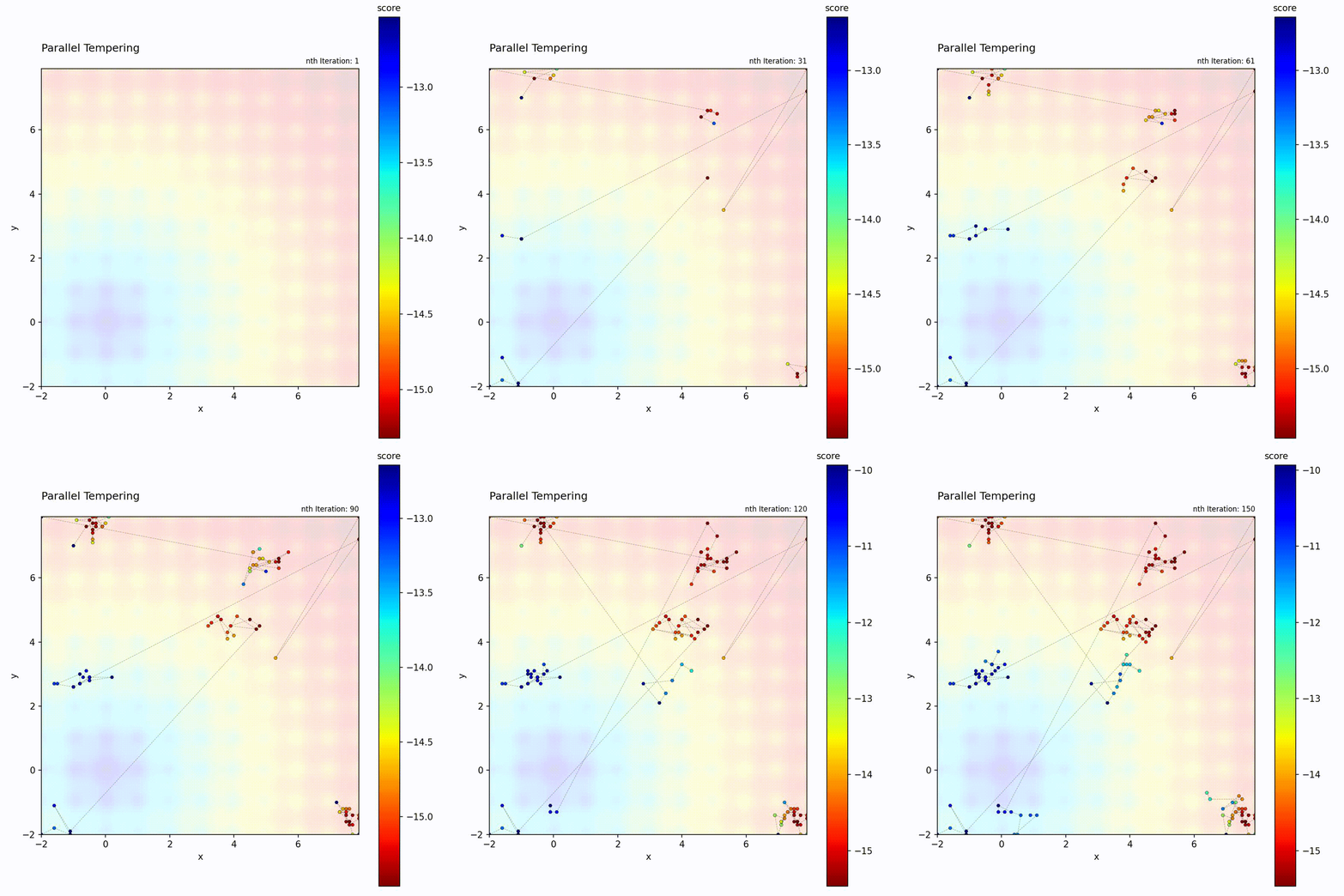
Multi-modal function: Hot replicas explore broadly while cold replicas exploit locally.
Parallel Tempering directly addresses the limitation of Simulated Annealing,
which must choose a single temperature schedule that trades off exploration
against exploitation over time. By maintaining replicas across the full
temperature range simultaneously, Parallel Tempering provides both broad
exploration and local refinement at every iteration. Among the population-based
optimizers in this library, it is the natural upgrade path when Simulated
Annealing gets stuck in local optima. It works well on multi-modal landscapes
with distinct basins. The n_iter_swap parameter controls swap frequency:
too-frequent swaps disrupt local convergence, while too-infrequent swaps reduce
the benefit of the temperature ladder.
Algorithm
The algorithm maintains a population of simulated annealers:
Each individual runs at a different temperature (cold to hot)
Cold individuals exploit local regions
Hot individuals explore broadly
Periodically, adjacent-temperature individuals may swap states
Swap criterion between replicas i and j:
p_swap = exp((score_i - score_j) * (1/temp_i - 1/temp_j))
Note
The swap mechanism creates a “temperature ladder” that allows good solutions to migrate from high-temperature (exploratory) replicas down to low-temperature (exploitative) replicas. This gives the algorithm both global exploration AND local precision simultaneously, unlike single SA which must choose between them over time.
The swap allows good solutions found at high temperatures to be refined at low temperatures, and stuck low-temperature individuals to escape via high-temperature exploration.
Parameters
Parameter |
Type |
Default |
Description |
|---|---|---|---|
|
int |
5 |
Number of temperature levels (replicas) |
|
int |
5 |
Iterations between swap attempts |
Example
import numpy as np
from gradient_free_optimizers import ParallelTemperingOptimizer

def multimodal(para):
    x, y = para["x"], para["y"]
    return -(np.sin(x) * np.sin(y) * np.exp(-0.01 * (x**2 + y**2)))

search_space = {
    "x": np.linspace(-10, 10, 100),
    "y": np.linspace(-10, 10, 100),
}

opt = ParallelTemperingOptimizer(
    search_space,
    population=6,     # 6 temperature levels
    n_iter_swap=10,   # Swap every 10 iterations
)

opt.search(multimodal, n_iter=500)
print(f"Best: {opt.best_para}, Score: {opt.best_score}")
When to Use
Good for:
Multi-modal landscapes with distinct basins
When single Simulated Annealing gets stuck
Problems requiring both exploration and exploitation
Compared to other methods:
vs. Single SA: Better exploration through temperature diversity
vs. PSO: Different mechanism (temperature vs. velocity)
vs. GA: Continuous-focused vs. discrete-friendly
3D Example with More Replicas
import numpy as np
from gradient_free_optimizers import ParallelTemperingOptimizer

def rastrigin_3d(para):
    A = 10
    vals = [para["x"], para["y"], para["z"]]
    return -(A * len(vals) + sum(
        v**2 - A * np.cos(2 * np.pi * v) for v in vals
    ))

search_space = {
    "x": np.linspace(-5.12, 5.12, 200),
    "y": np.linspace(-5.12, 5.12, 200),
    "z": np.linspace(-5.12, 5.12, 200),
}

opt = ParallelTemperingOptimizer(
    search_space,
    population=10,
    n_iter_swap=5,
)

opt.search(rastrigin_3d, n_iter=1000)
print(f"Best: {opt.best_para}")
print(f"Score: {opt.best_score}")
Trade-offs
Exploration vs. exploitation: Naturally balanced through the temperature ladder. More replicas give finer temperature resolution.
Computational overhead: Linear in the number of replicas. Each replica is a separate SA instance.
Parameter sensitivity:
n_iter_swapis critical. Too frequent swaps disrupt local convergence; too infrequent swaps miss the benefit of temperature exchange.