

Stochastic Hill Climbing
Stochastic Hill Climbing extends Hill Climbing by accepting worse solutions with
a fixed probability p_accept. In each iteration, the algorithm generates
neighboring candidates and evaluates them. If a candidate improves the current
score, the move is accepted. If the candidate is worse, the algorithm accepts
it with probability p_accept and rejects it otherwise. This constant
acceptance rate allows the search to escape shallow local optima that would
permanently trap a purely greedy strategy.
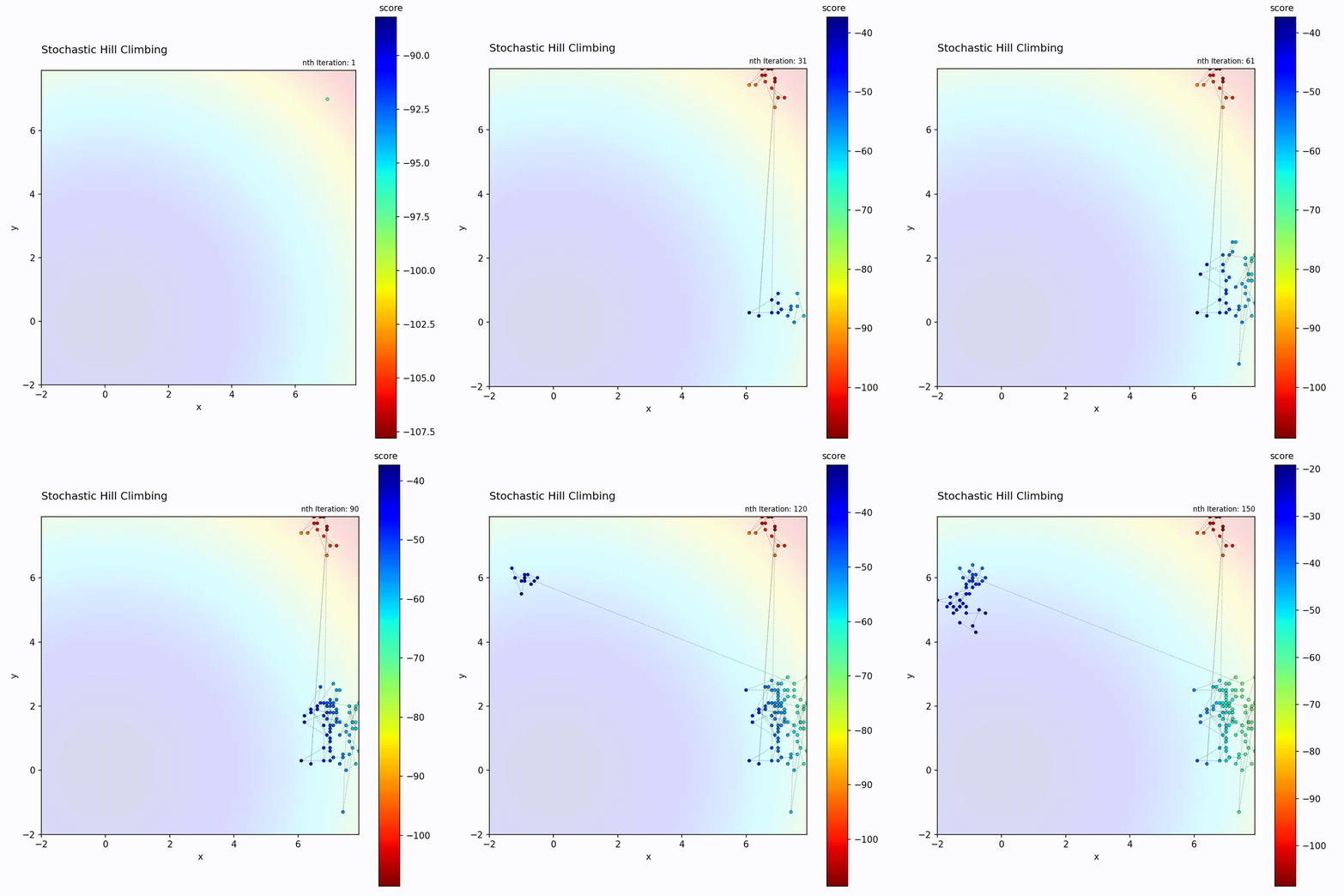
Convex function: Still converges well, with occasional exploratory moves.
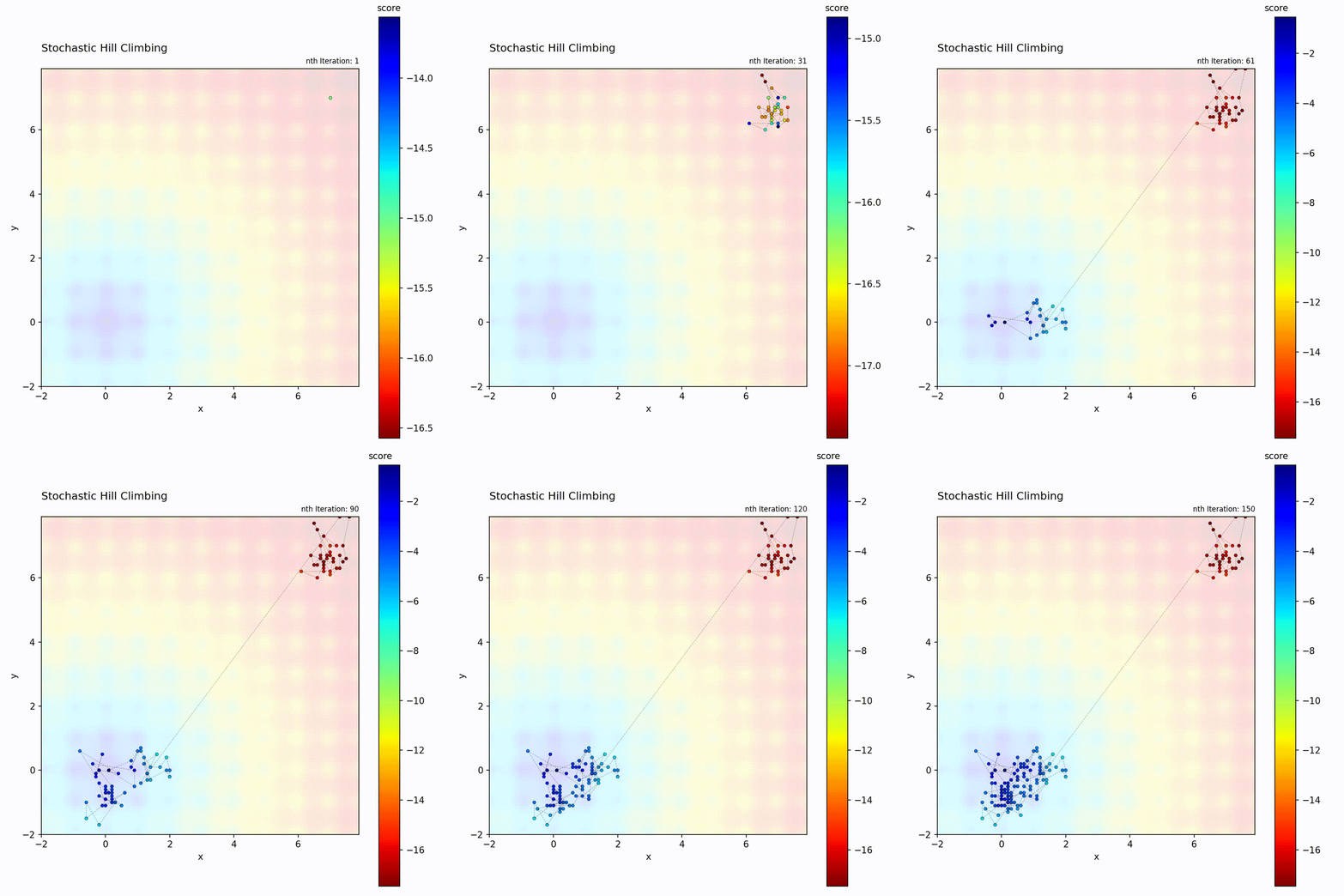
Multi-modal function: Better exploration than standard Hill Climbing.
Stochastic Hill Climbing sits between standard Hill Climbing and Simulated
Annealing in terms of escape capability. Unlike Simulated Annealing, which
decreases its acceptance probability over time via a cooling schedule, Stochastic
Hill Climbing maintains a constant p_accept throughout the search. This means
the algorithm never transitions from exploration to exploitation; it applies the
same level of randomness from start to finish. Choose it over Hill Climbing when
the objective landscape contains shallow local optima, and over Simulated
Annealing when you want a single, fixed exploration rate without tuning a cooling
schedule.
Algorithm
At each iteration:
Generate neighbors within
epsilondistanceEvaluate neighbors
If a neighbor is better, move to it
If a neighbor is worse, move to it with probability
p_accept
if score(neighbor) > score(current):
    accept move
else:
    accept with probability p_accept
Note
Unlike Simulated Annealing where acceptance probability decreases over time via a temperature schedule, Stochastic Hill Climbing uses a constant acceptance probability throughout the entire search. This means it never fully transitions to pure exploitation, providing continuous escape capability at the cost of convergence precision.
Parameters
Parameter |
Type |
Default |
Description |
|---|---|---|---|
|
float |
0.5 |
Probability of accepting a worse solution |
|
float |
0.03 |
Step size as fraction of search space |
|
str |
“normal” |
Step distribution |
|
int |
3 |
Number of neighbors per iteration |
The p_accept Parameter
p_accept = 0.0: Equivalent to standard Hill Climbingp_accept = 0.5: Default, balanced explorationp_accept = 1.0: Random walk (accepts all moves)
Tip
Start with the default p_accept=0.5. Decrease if the optimization
is too erratic; increase if it gets stuck in local optima.
Example
import numpy as np
from gradient_free_optimizers import StochasticHillClimbingOptimizer

def rastrigin(para):
    x, y = para["x"], para["y"]
    A = 10
    return -(A * 2 + (x**2 - A * np.cos(2 * np.pi * x))
                  + (y**2 - A * np.cos(2 * np.pi * y)))

search_space = {
    "x": np.linspace(-5.12, 5.12, 100),
    "y": np.linspace(-5.12, 5.12, 100),
}

opt = StochasticHillClimbingOptimizer(
    search_space,
    p_accept=0.3,    # Conservative acceptance
    epsilon=0.05,
)

opt.search(rastrigin, n_iter=1000)
print(f"Best: {opt.best_para}, Score: {opt.best_score}")
When to Use
Good for:
Functions with shallow local optima
When standard Hill Climbing gets stuck
Landscapes with noise or small perturbations
Compared to Simulated Annealing:
Stochastic Hill Climbing has a constant acceptance probability, while Simulated Annealing decreases it over time. Use Simulated Annealing when you want to explore broadly at first and exploit later.
Higher-Dimensional Example
import numpy as np
from gradient_free_optimizers import StochasticHillClimbingOptimizer

def ackley_3d(para):
    import math
    vals = [para["x"], para["y"], para["z"]]
    n = len(vals)
    sum_sq = sum(v**2 for v in vals) / n
    sum_cos = sum(np.cos(2 * math.pi * v) for v in vals) / n
    return -(- 20 * np.exp(-0.2 * np.sqrt(sum_sq))
             - np.exp(sum_cos) + 20 + math.e)

search_space = {
    "x": np.linspace(-5, 5, 200),
    "y": np.linspace(-5, 5, 200),
    "z": np.linspace(-5, 5, 200),
}

opt = StochasticHillClimbingOptimizer(
    search_space,
    p_accept=0.2,
    epsilon=0.05,
    n_neighbours=5,
)

opt.search(ackley_3d, n_iter=2000)
print(f"Best: {opt.best_para}")
print(f"Score: {opt.best_score}")
Trade-offs
Exploration vs. exploitation:
p_acceptdirectly controls this balance. Higher values give more exploration but slower convergence.Computational overhead: Same as Hill Climbing (minimal).
Parameter sensitivity: The
p_acceptparameter is critical. Values near 1.0 degrade to a random walk; values near 0.0 reduce to standard Hill Climbing.