

Optimizer Selection
GFO provides 23 optimization algorithms organized into four categories. Each category uses a fundamentally different search strategy, making some algorithms better suited to certain problem types than others. Local search algorithms exploit promising regions efficiently but can get stuck in local optima. Global search algorithms explore broadly but may be slow to converge. Population-based methods maintain multiple candidate solutions simultaneously. Sequential model-based optimization (SMBO) builds a surrogate model of the objective function to make informed decisions about where to search next.
Hill Climbing, Simulated Annealing, Downhill Simplex. Best for exploiting promising regions.
Random Search, Grid Search, Pattern Search, DIRECT. Best for broad exploration.
Particle Swarm, Genetic Algorithm, Evolution Strategy. Best for parallel evaluation.
Bayesian, TPE, Forest. Best for expensive objective functions.
Decision Tree
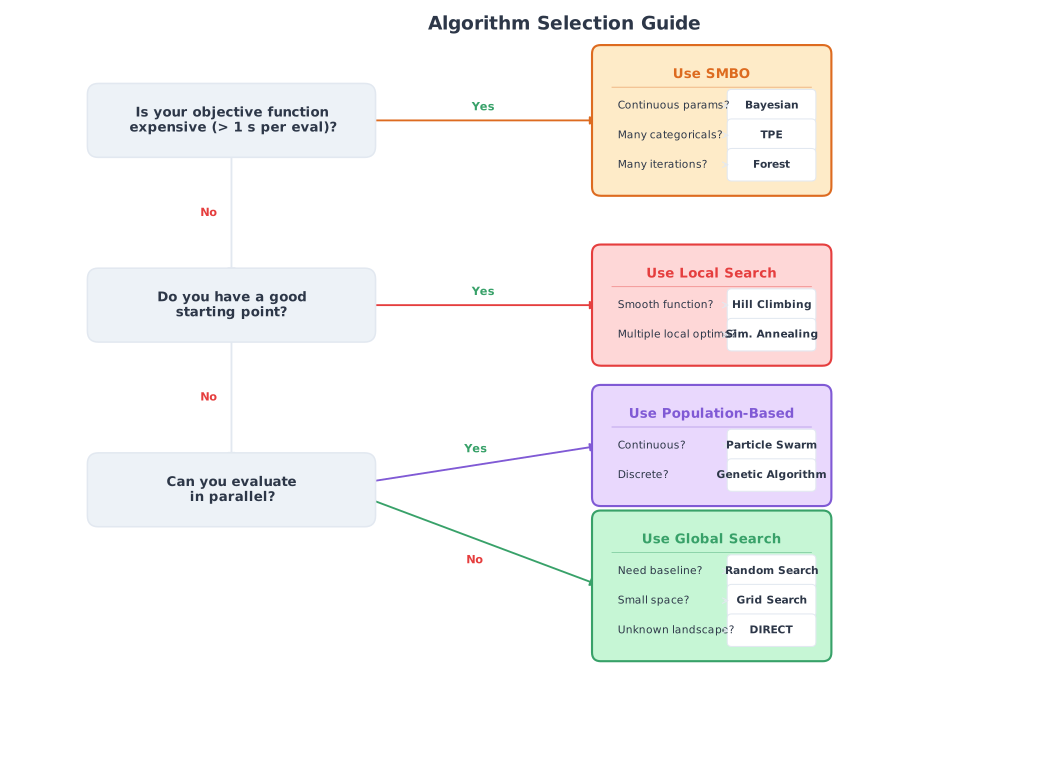
Follow the decision tree to find the best algorithm for your problem.
Text version of the decision tree
Is your objective function expensive (> 1 second)?
├── Yes → Use SMBO (Bayesian, TPE, Forest)
│         └── Continuous params? → BayesianOptimizer
│         └── Many categoricals? → TreeStructuredParzenEstimators
│         └── Many iterations? → ForestOptimizer
│
└── No → Continue...

Do you have a good starting point?
├── Yes → Use Local Search
│         └── Smooth function? → HillClimbingOptimizer
│         └── Multiple local optima? → SimulatedAnnealingOptimizer
│
└── No → Continue...

Can you evaluate in parallel?
├── Yes → Use Population-Based
│         └── Continuous? → ParticleSwarmOptimizer
│         └── Discrete? → GeneticAlgorithmOptimizer
│
└── No → Use Global Search
          └── Need baseline? → RandomSearchOptimizer
          └── Small space? → GridSearchOptimizer
          └── Unknown landscape? → DirectAlgorithm
By Problem Type
Hyperparameter Tuning (ML)
First choice:
BayesianOptimizer(efficient with expensive training)With many categoricals:
TreeStructuredParzenEstimatorsLarge search spaces:
ForestOptimizerQuick baseline:
RandomSearchOptimizer
Continuous Optimization
Smooth, unimodal:
HillClimbingOptimizerMulti-modal:
SimulatedAnnealingOptimizerorParticleSwarmOptimizerNeed global guarantee:
DirectAlgorithm
Discrete/Combinatorial
Feature selection:
GeneticAlgorithmOptimizerMixed spaces:
TreeStructuredParzenEstimatorsSmall discrete space:
GridSearchOptimizer
Unknown Landscape
Start with
RandomSearchOptimizerto exploreThen refine with
BayesianOptimizerorSimulatedAnnealingOptimizer
By Evaluation Budget
Budget |
Recommended Optimizers |
|---|---|
< 50 iterations |
Bayesian, TPE (learn quickly) |
50-200 iterations |
Bayesian, Forest, SimulatedAnnealing |
200-1000 iterations |
Forest, ParticleSwarm, EvolutionStrategy |
> 1000 iterations |
Any (cheaper algorithms work well) |
By Function Cost
Very cheap (< 0.01s per evaluation)
Use simple algorithms: Hill Climbing, Random Search
SMBO overhead may dominate
Cheap (0.01s - 1s)
Most algorithms work well
Population-based gives good coverage
Expensive (1s - 60s)
SMBO algorithms (Bayesian, TPE, Forest)
Enable memory caching
Very expensive (> 60s)
Bayesian Optimization is most sample-efficient
Consider parallelization with Hyperactive
Algorithm Characteristics
Algorithm |
Exploration |
Exploitation |
Notes |
|---|---|---|---|
Hill Climbing |
Low |
High |
Fast, may get stuck |
Simulated Annealing |
Medium |
High |
Good general-purpose |
Random Search |
High |
Low |
Great baseline |
Particle Swarm |
Medium |
Medium |
Good for parallelism |
Genetic Algorithm |
High |
Medium |
Good for discrete |
Bayesian |
Adaptive |
Adaptive |
Best for expensive |
TPE |
Adaptive |
Adaptive |
Handles categoricals well |
Starting Recommendation
If unsure, this progression often works well:
RandomSearchOptimizer (10% of budget) - establish baseline
BayesianOptimizer or SimulatedAnnealingOptimizer (90% of budget) - optimize
Or for very limited budgets:
BayesianOptimizer with
xi=0.1(higher exploration) for first halfBayesianOptimizer with
xi=0.01(higher exploitation) for second half