

Optimization Algorithms
Gradient-Free-Optimizers provides 23 optimization algorithms organized into four categories based on their search strategy. Each algorithm has unique characteristics that make it suitable for different types of problems.
Algorithm Overview
Algorithm |
Category |
Best For |
|---|---|---|
Local |
Smooth, unimodal functions with good starting points |
|
Local |
Functions with minor noise or small local optima |
|
Local |
Escaping flat regions or plateaus |
|
Local |
Functions with multiple local optima |
|
Local |
Low-dimensional continuous optimization |
|
Global |
Baseline comparison, embarrassingly parallel |
|
Global |
Systematic coverage of small search spaces |
|
Global |
Combining local refinement with global exploration |
|
Global |
Broad initial exploration with gradual focusing |
|
Global |
Derivative-free optimization without randomness |
|
Global |
Separable objective functions |
|
Global |
Functions with known smoothness bounds |
|
Global |
Guaranteed global convergence |
|
Population |
Continuous optimization with multiple processors |
|
Population |
Balanced exploration and exploitation |
|
Population |
Multi-modal landscapes with distinct basins |
|
Population |
Discrete/combinatorial optimization |
|
Population |
Continuous optimization with noise |
|
Population |
Continuous non-linear optimization |
|
Population |
Continuous optimization with adaptive covariance |
|
SMBO |
Expensive functions with continuous parameters |
|
SMBO |
Expensive functions, especially with conditionals |
|
SMBO |
Large search spaces with discrete parameters |
Categories
Algorithms that explore the neighborhood of the current best solution. Fast and efficient for smooth functions, but may get stuck in local optima.
Algorithms: Hill Climbing, Stochastic Hill Climbing, Repulsing Hill Climbing, Simulated Annealing, Downhill Simplex
Algorithms designed to explore the entire search space. Better at avoiding local optima but may be slower to converge.
Algorithms: Random Search, Grid Search, Random Restart, Random Annealing, Pattern Search, Powell’s Method, Lipschitz, DIRECT
Multiple search agents work together, sharing information about good regions. Natural parallelism and diverse exploration.
Algorithms: Particle Swarm, Spiral, Parallel Tempering, Genetic Algorithm, Evolution Strategy, Differential Evolution, CMA-ES
Build a surrogate model of the objective function to predict promising regions. Ideal for expensive evaluations.
Algorithms: Bayesian Optimization, TPE, Forest Optimizer
How to Choose
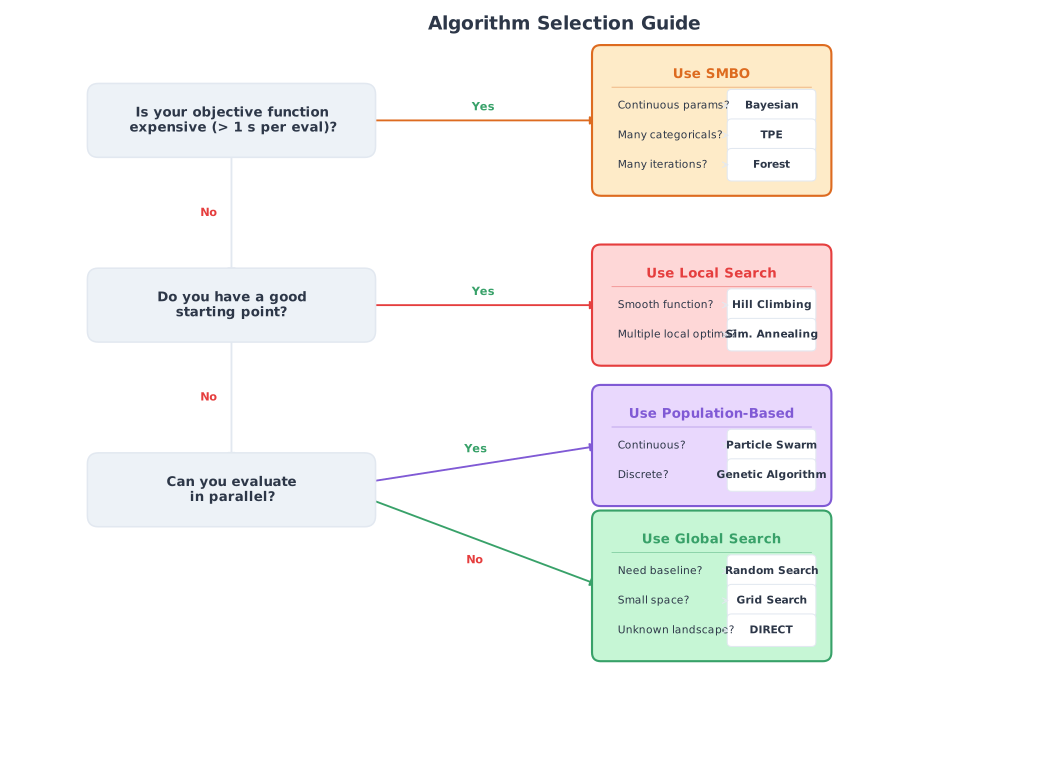
Use this decision tree to narrow down the best algorithm category for your problem. For a more detailed guide, see Optimizer Selection.
Tip
Quick Decision Guide:
Is your objective function expensive to evaluate?
Yes: Use SMBO algorithms (Bayesian, TPE, Forest)
No: Continue to question 2
Do you have a good starting point?
Yes: Start with local search (Hill Climbing, Simulated Annealing)
No: Continue to question 3
Can you parallelize evaluations?
Yes: Use population-based (Particle Swarm, Genetic Algorithm)
No: Use global search (Random Search, Pattern Search)
Computational Cost
Algorithms differ in their computational overhead (time spent in the optimizer vs. evaluating the objective function):
Category |
Overhead |
Notes |
|---|---|---|
Local Search |
Very Low |
Simple neighbor generation |
Global Search |
Very Low |
Random/grid sampling |
Population-Based |
Low |
Population management overhead |
SMBO |
High |
Model training and prediction |
For expensive objective functions (training ML models, running simulations), the overhead is negligible. For cheap functions (mathematical expressions), consider the simpler algorithms.